Certification Gaps Can Turn a Sanitary Ware Order Into a Supply Chain Crisis
Importing sanitary ware without checking the right certifications can create a costly chain reaction. A toilet or basin may pass your factory inspection yet fail a destination-market requirement, causing customs delays, product rejection, relabelling costs, or even a market recall. The problem becomes worse when a Supplier provides an outdated certificate that does not match the exact model, factory, or production site. For wholesalers and project buyers, the real risk is not simply buying an uncertified product. It is discovering the compliance gap after containers have shipped. A professional purchasing process therefore verifies market requirements, product scope, certificate validity, and supporting test reports before issuing the final purchase order.
A qualified sanitary ware Supplier should provide market-relevant certifications, traceable test reports, factory quality controls, and complete compliance documentation. WEESUM combines export-oriented manufacturing, international certifications, OEM and ODM capability, and factory quality management to support wholesale buyers with different market requirements.
But certificates are only one part of the real purchasing picture. The following guide reveals the practical checks experienced importers use to connect product compliance, factory capability, documentation, and commercial risk before placing a large order.
Sanitary Ware Certifications at a Glance
There is no single global certificate that automatically makes every ceramic basin or toilet acceptable everywhere. The correct compliance package depends on the destination country, product type, intended installation, water-contact components, and local building or plumbing rules. A professional Manufacturer should therefore begin with the destination market rather than simply sending the certificates already available.
| Market | Common Compliance Focus | Purchasing Check |
|---|---|---|
| North America | cUPC, applicable plumbing standards, water-efficiency requirements | Verify exact model, test report and certification scope |
| European Union | CE marking where applicable, applicable EN standards, product documentation | Confirm whether the product actually falls under a CE regime |
| United Kingdom | CE/UKCA framework where applicable, WRAS approval where required by the application | Check current GB requirements and water-fitting rules |
| Australia | WaterMark, WELS where applicable | Check registration and water-efficiency requirements |
| Middle East | SASO/SABER and destination-specific requirements | Confirm importer and shipment compliance before production |
The most important lesson is simple: a certificate is valuable only when its scope matches the product you are actually buying. A Supplier may hold several international certificates, but that does not mean every basin, toilet, glaze, flushing system, or customized model is automatically covered. Ask for the certificate number, model list, issuing body, validity, test standard, and factory address. This creates a basic traceability chain from certification to production.
North America — cUPC
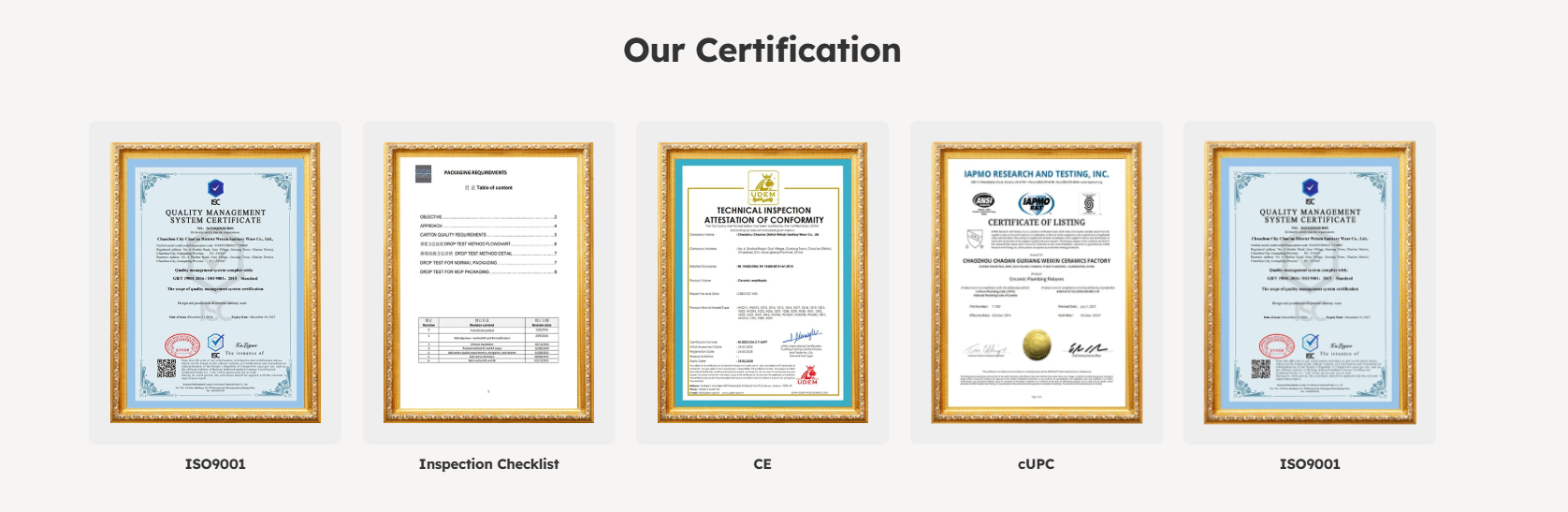
For North American sanitary ware buyers, cUPC certification is an important compliance consideration for many plumbing products. The certification demonstrates conformity with applicable plumbing standards and is widely recognized within the North American plumbing industry. However, buyers should never treat the cUPC logo alone as sufficient evidence of compliance.
The purchasing team should verify whether the exact toilet or basin model appears within the certification scope. This is especially important for OEM and ODM projects because a customized product may differ from the original certified configuration. Changes to flushing components, dimensions, materials, fittings, or water-use characteristics can affect compliance.
- Request the current cUPC certificate and certification number.
- Check the exact product model and manufacturing location.
- Match the certificate with the latest technical drawings.
- Request relevant test reports and water-use data.
- Confirm whether private-label changes affect certification scope.
For a wholesale importer, this verification is an essential pre-shipment compliance checkpoint. A professional Manufacturer should be able to explain exactly which models are certified and which products require additional testing. This reduces the risk of customs problems, failed inspections, or costly rework after arrival.
Europe and the UK — CE Marking and WRAS
European sanitary ware compliance requires careful distinction between a product standard and a conformity marking. CE marking is not a universal sanitary ware certificate. It applies only where relevant EU legislation requires it. For ceramic sanitary appliances, buyers should identify the applicable harmonized or designated standards and determine whether CE marking is legally required for the specific product.
In the UK, the situation also depends on the product category and market. Great Britain currently recognizes CE marking for construction products under applicable arrangements, while UKCA remains part of the regulatory framework. Separately, WRAS approval is relevant to water fittings and products where UK water regulations and water-supply requirements apply.
What should a buyer verify?
- The applicable EN standard or UK designated standard.
- Whether CE marking is legally required for the exact product.
- Whether WRAS approval is required for associated water fittings or components.
- The Declaration of Performance, declaration of conformity, or relevant technical documentation where applicable.
- The relationship between the certificate, product model, factory, and production version.
The commercial risk is highest when a Supplier simply says CE certified without identifying the applicable regulation or standard. Experienced buyers request evidence first and place the order second.
Australia, the Middle East and Beyond
Australia demonstrates why destination-specific compliance matters. For plumbing and sanitary products within its scope, WaterMark certification can be a critical market-access requirement. Water-efficiency requirements may also apply through the WELS scheme, depending on the product. A basin, toilet, smart toilet, or flushing component should therefore be evaluated according to its exact regulatory category rather than treated as generic ceramic ware.
In the Middle East, requirements can vary by country and product application. Buyers may encounter SASO, SABER, local conformity procedures, project specifications, or authority-specific requirements. The same Supplier may therefore need different documentation for Saudi Arabia, the UAE, Qatar, or other markets.
Build a market-specific compliance matrix
- Identify the destination country and importer of record.
- Define the exact product category and intended use.
- List mandatory certifications and registration requirements.
- Confirm applicable testing standards and documentation.
- Obtain written confirmation before mass production.
This process is particularly important for Customizable products. When the basin color, glaze, dimensions, flushing system, or branding changes, the buyer should confirm whether the existing compliance documents remain valid. This prevents a certificate mismatch from becoming a shipment rejection or project delay.
Water-Efficiency Labels and the Ceramic Behind Them
Water efficiency is increasingly important because toilets are judged not only by appearance but also by measurable flushing performance. Depending on the market, buyers may encounter WELS, WaterSense, local water-efficiency labels, or project-specific water-use requirements. The exact label is determined by the destination market and product category.
For procurement teams, water efficiency should be connected to the entire product system. Ceramic quality provides the structural platform, but flushing performance also depends on the cistern, flush valve, trapway design, water volume, hydraulic configuration, and manufacturing consistency. A visually attractive toilet is not commercially successful if it cannot deliver consistent performance under the required testing conditions.
Key procurement checks
- Confirm the declared flush volume or water consumption.
- Request the relevant water-efficiency test report.
- Verify that the tested configuration matches the production model.
- Check whether private-label or OEM modifications require retesting.
- Include water-use requirements in the technical specification.
For large-volume buyers, consistent ceramic dimensions and firing quality are also important because manufacturing variation can affect component assembly and flushing performance. A capable Manufacturer should therefore combine quality control, process inspection, and performance testing rather than treating certification as paperwork alone.
Beyond the Product — Factory and Social Audits
Product certification answers one question: can this product meet a defined requirement? A factory audit answers another: can the Supplier consistently produce it at the required quality and volume? For serious importers, both questions matter.
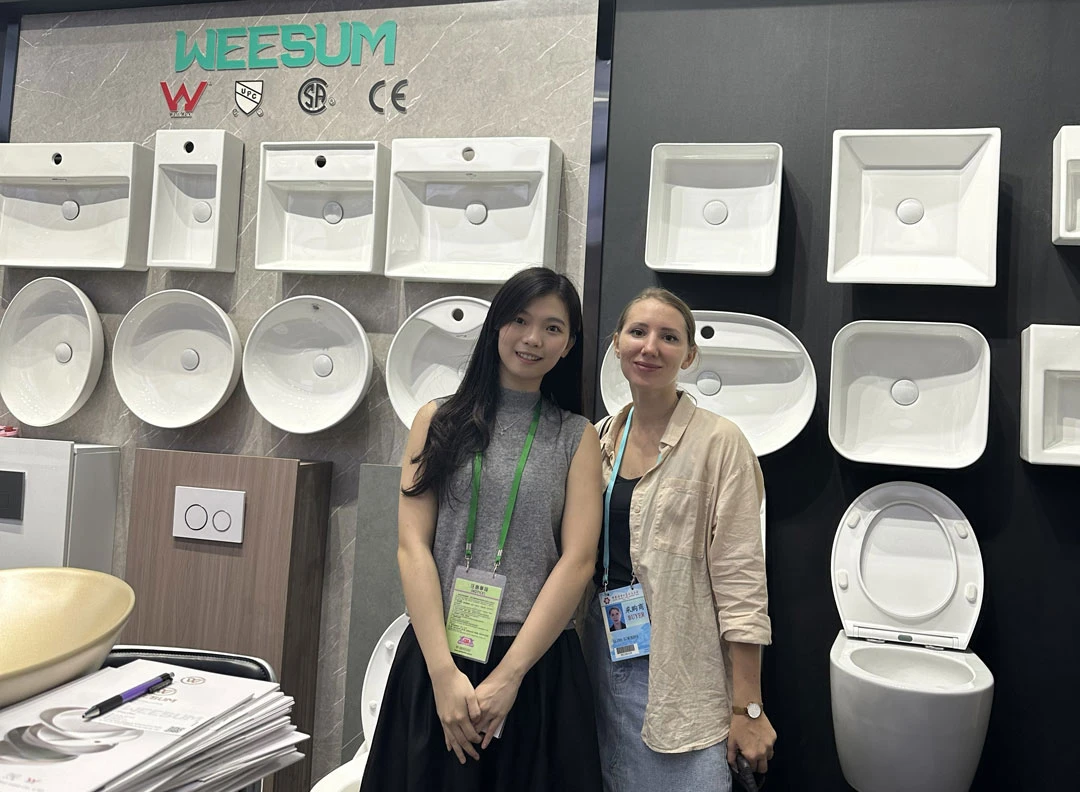
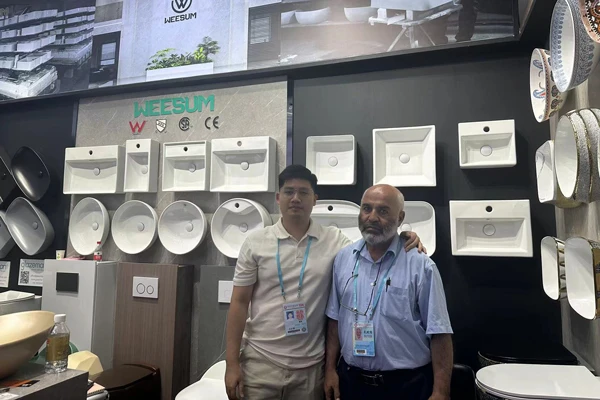
Useful audit areas include production capacity, raw-material control, mold management, glazing, kiln firing, dimensional inspection, finished-product inspection, packaging, warehouse management, traceability, and corrective-action procedures. WEESUM describes a large manufacturing base in Chaozhou with high-pressure casting, automated production facilities, tunnel kiln firing, and finished-product inspection, providing a useful foundation for evaluating production consistency.
Social compliance is a separate dimension. Buyers may request BSCI, SMETA, or other customer-specific social audits depending on their retail or corporate procurement requirements. These audits can cover labor practices, working conditions, health and safety, and ethical business practices.
Recommended audit sequence
- Factory qualification audit before supplier approval.
- Production process audit before mass production.
- Pre-shipment inspection before container loading.
- Corrective action review when non-conformities are identified.
This layered approach reduces supplier dependency, quality disputes, and delivery risk more effectively than relying on a certificate alone.
Confirm the Right Certifications Before You Order
The best time to confirm certification is before the purchase order, not after production begins. This is especially important for wholesalers launching a new range or private-label brand because compliance requirements can influence product selection, packaging, labeling, testing costs, and lead time.
A practical pre-order workflow
- Define the destination country and sales channel.
- List every product model, including customized models.
- Identify mandatory certifications and applicable standards.
- Request certificates and supporting test reports.
- Check certificate validity, scope, model number, factory address, and issuing body.
- Confirm whether certification covers the exact production configuration.
- Record all requirements in the purchase specification.
- Repeat critical checks before shipment.
For OEM and ODM projects, add a formal change-control procedure. Any change to ceramic dimensions, glaze, fittings, flushing components, packaging, logo, or manufacturing location should trigger a compliance review. This simple control prevents the common certificate mismatch problem in which the document is valid but no longer accurately represents the shipped product.
A professional Supplier should not resist these questions. Clear certification documentation is part of professional export service and should be treated as a normal purchasing requirement.
What Documentation to Request
A reliable procurement file should contain more than a single certificate PDF. The objective is to create a complete compliance dossier that can be reviewed by your purchasing, quality, customs, and project teams.
| Document | Why It Matters | Buyer Check |
|---|---|---|
| Certificate | Confirms formal certification status | Model, scope, validity, factory |
| Test Report | Shows technical testing evidence | Standard, laboratory, tested configuration |
| Declaration | Supports regulatory conformity | Manufacturer and applicable legislation |
| Technical Drawing | Defines production configuration | Dimensions, interfaces, components |
| Product Specification | Controls commercial requirements | Material, finish, water use, packaging |
| Factory Audit Report | Evaluates manufacturing capability | Capacity, QC, traceability, corrective actions |
| Inspection Report | Confirms shipment quality | Quantity, appearance, dimensions, function |
For customized products, also request approved samples, signed specifications, packaging artwork, labeling requirements, and a documented golden sample. Keep these records together with the purchase order so that quality inspection has an objective reference.
WEESUM states that it supports international wholesale, project supply, private-label cooperation, and both light customization and deeper OEM/ODM development. Its published certification portfolio includes ISO9001, CE, cUPC, NSF, WaterMark, SASO, and BSCI. Buyers should nevertheless verify the current certificate documents and exact product scope for each project before ordering.
Choose Compliance Before Price, Then Choose the Right Supplier
The right sanitary ware Supplier is not simply the one offering the lowest quotation. Choose a Manufacturer that can connect certification, factory quality, documentation, customization, and shipment control. For your next wholesale, OEM, or ODM project, contact WEESUM to confirm the certification package and product compliance requirements before production.